
The organiser wants a puzzle activity, but the group isn't a single type of player. One child may enjoy pictures and matching symbols, while an adult wants a proper cipher. A classroom needs clear instructions and manageable materials, a birthday party needs quick wins, and a team-building session needs a format that stops one confident solver from taking over.
The best code breaking games match the challenge to the group's age, size, confidence, attention span and available time. The ten formats below move from accessible visual activities to immersive, role-based challenges. Each includes practical setup advice, likely playtime, difficulty considerations and a grounded alternative at Chronos One Escape Rooms Eltham for groups that want a professionally hosted, story-led 60-minute experience.
Table of Contents
- 1. Classic Cipher and Code-Breaking Puzzles
- 2. Logic Grid and Deduction Puzzles
- 3. UV Light and Hidden Message Reveals
- 4. Sequential Code-Breaking with Progressive Difficulty
- 5. Pattern Recognition and Symbol-Matching Puzzles
- 6. Collaborative Code-Breaking Requiring Role Distribution
- 7. Audio and Spoken-Word Code-Breaking Challenges
- 8. Digital and Interactive Code-Breaking Tools
- 9. Narrative-Embedded Codes Requiring Story Context to Solve
- 10. Red Herring and Misdirection Code Strategies
- Code-Breaking Games: 10-Point Comparison
- Turn a Puzzle Idea into a Complete Group Experience
1. Classic Cipher and Code-Breaking Puzzles
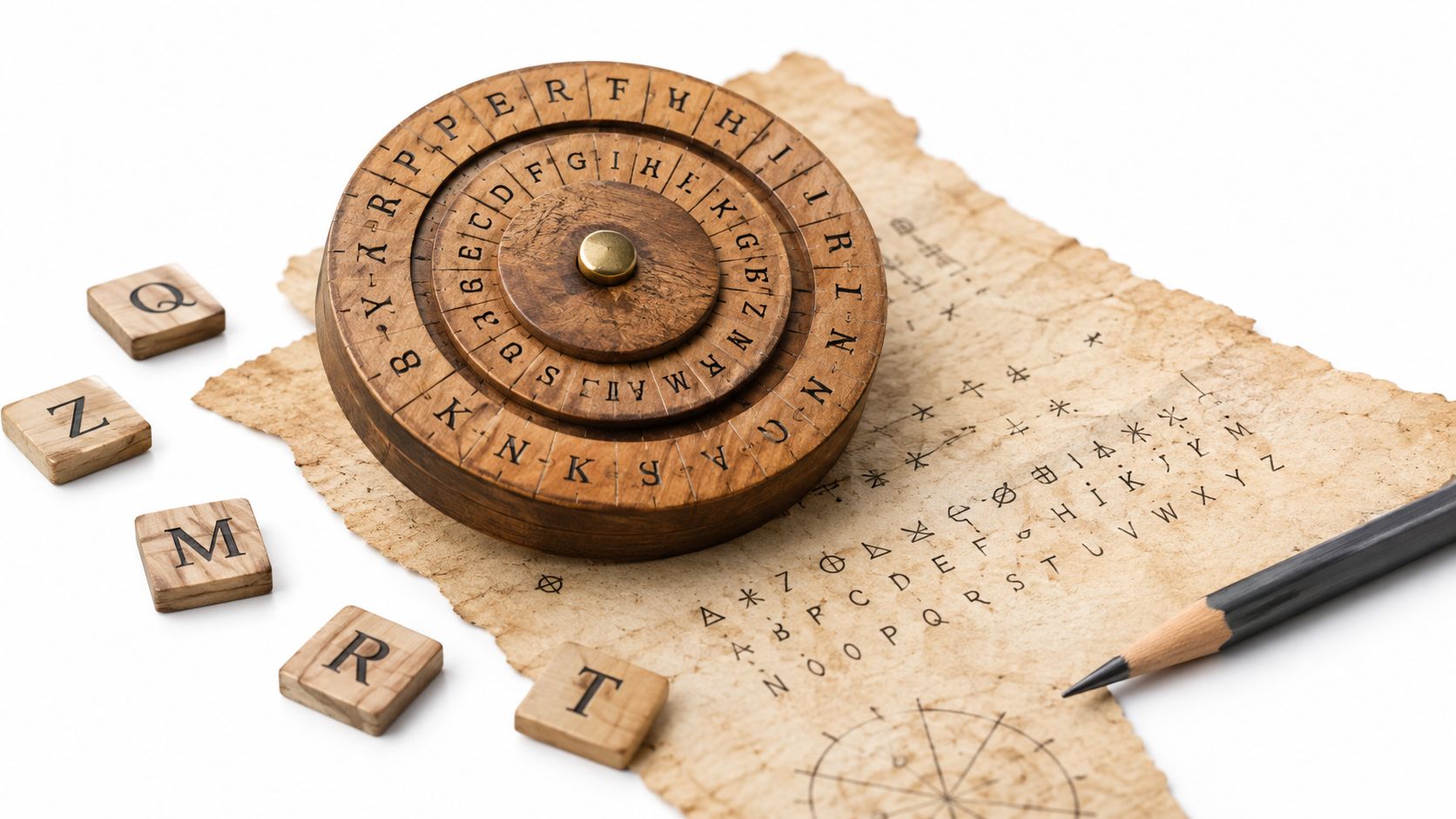
Substitution ciphers, Caesar shifts and symbol alphabets are the clearest introduction to code breaking games. Players replace one letter with another, move letters through the alphabet or match unfamiliar symbols to a supplied key. The activity works on paper, in a classroom station or as one stage of a larger escape-room challenge.
For a family group, use a short message with a visible cipher key and a familiar instruction such as “LOOK UNDER THE TABLE”. For adults, remove some of the support and add a decoder wheel, a frequency hint or a second message that confirms the first answer. The main trade-off is accessibility versus discovery. If the key is too obvious, players just follow instructions. If it's too obscure, they may spend the entire session guessing the cipher type rather than solving the puzzle.
Practical rule: Give beginners a way to identify the method before asking them to decode the message.
The UK's strongest cultural reference point for this mechanic is Bletchley Park. The Government Code and Cypher School began setting up there in 1938–39, and the site became the centre of British wartime code-breaking. At its peak, the operation involved more than 10,000 people, with 75% women, while the Bombe and Colossus helped turn decryption into a systematic technical process. Mensa's overview of Bletchley Park and code-breaking provides useful historical inspiration for spy, wartime and archive themes.
For a hosted alternative, manage your escape room bookings around a private room rather than building every prop yourself. Chronos One Escape Rooms Eltham offers a professionally briefed setting where groups can encounter puzzle-led play without needing to prepare a complete cipher activity at home.
2. Logic Grid and Deduction Puzzles
Logic grids reward patience rather than specialist code knowledge. Players receive statements such as “the red key wasn't in the library” or “Sam arrived after Priya”, then cross out impossible combinations until only one arrangement remains. A completed grid can reveal a number, a name or the order of objects needed for the next stage.
For a family room, keep the grid compact and use three or four variables, such as people, rooms and objects. Adult groups can handle more relationships, but complexity shouldn't come from vague wording. Every clue must narrow the possibilities in a way that can be checked on the page.
A printed grid is better than asking players to hold every deduction in their heads. It also makes collaboration visible. One person can read the clues, another can mark exclusions and a third can challenge assumptions. The format suits classrooms particularly well because the teacher can discuss reasoning rather than only checking whether the final combination is correct.
Make the deduction chain fair
Use names, places and objects that belong to the story. A museum-themed puzzle might connect visitors, exhibits and times, while a pirate party could connect crew members, maps and treasure locations. Avoid adding an extra variable just to make the puzzle look difficult. More information creates more writing and more opportunities for an accidental ambiguity.
A useful hint reveals a logical step, not the answer. “The green token can't be in either room already ruled out” keeps the group thinking, whereas handing over the final row removes the activity. Test the puzzle with someone who hasn't seen the solution, because a designer often assumes a connection that players won't notice.
Chronos One Escape Rooms Eltham is a practical alternative when you want staff briefing, a fixed session and a private group format instead of printing and supervising a deduction grid. The venue lists family, children's party, school and corporate options, but its published room descriptions shouldn't be treated as a guarantee that every room uses a logic grid.
3. UV Light and Hidden Message Reveals
A hidden message creates an immediate discovery moment. Players search a map, diary, wall or prop with a UV torch, then reveal text, symbols or coordinates that weren't visible under ordinary light. The revealed material can stand alone as an instruction or become the key for a second cipher.
This format is easy to run at a party, but the prop must be part of the puzzle rather than a piece of equipment players are expected to find by luck. Label the torch, place it beside a suggestive clue or include a clear instruction to inspect the supplied objects. Use invisible ink for information that directly moves the game forward. A glowing red herring feels like a technical trick rather than a satisfying deduction.
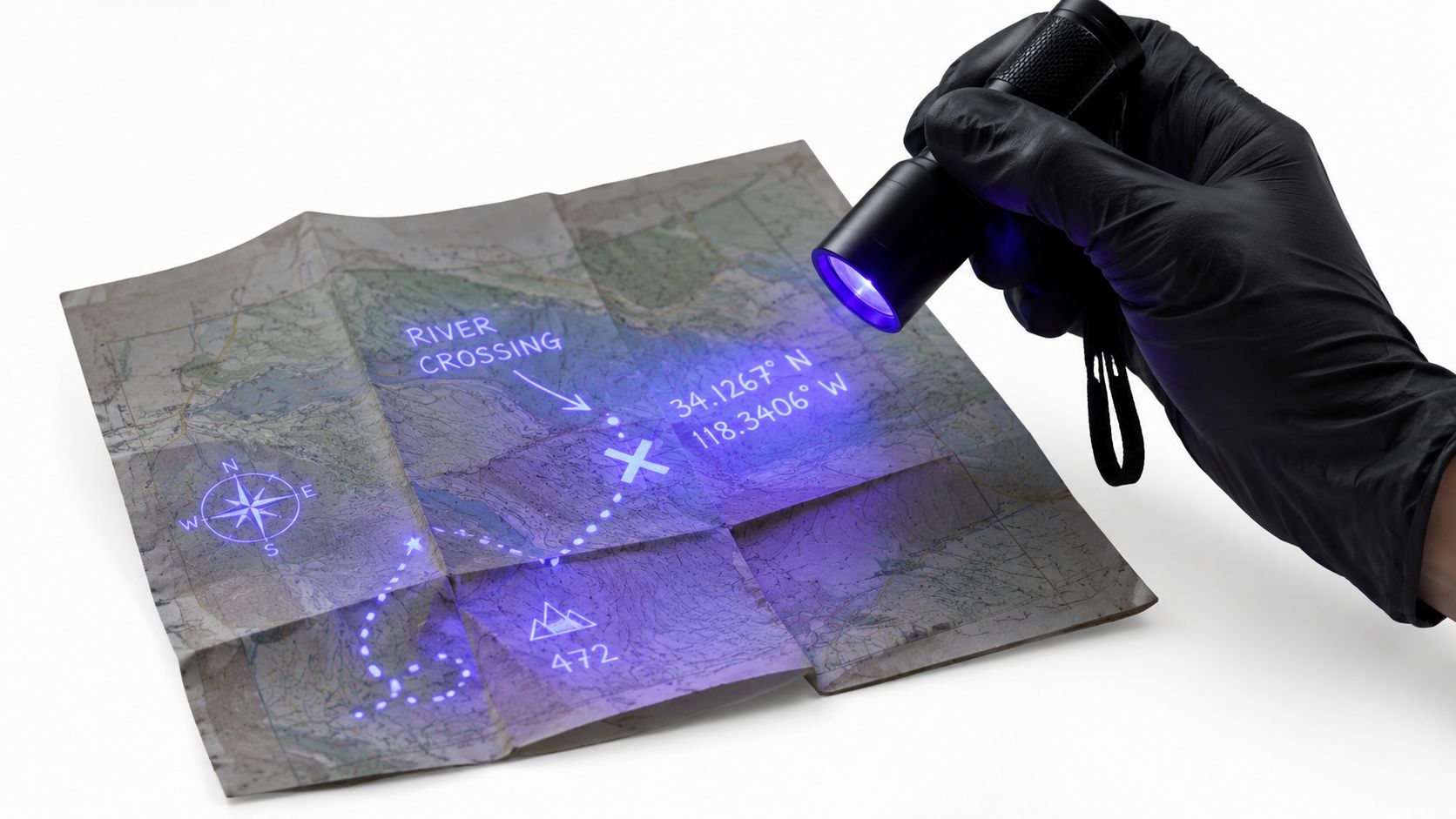
Test the reveal in the actual room, not just under ideal lighting. Bright daylight can wash out weak markings, and a message that looks clear on a workbench may disappear when players hold the torch at an angle. For younger groups, use large symbols and a short instruction. For experienced players, hide the reveal among several relevant surfaces and let the story explain why the message is concealed.
Combine discovery with decoding
The strongest version doesn't end when the ink appears. The UV message might provide a Caesar-shifted phrase, a sequence of compass points or the names needed for a logic puzzle. That gives the group two kinds of satisfaction, finding the hidden layer and working out what it means.
Use escape-room ideas for code-breaking activities when adapting this mechanic for a home game or classroom. Chronos One Escape Rooms Eltham is the grounded alternative for groups that want a hosted escape-room environment rather than sourcing UV pens, testing lighting and resetting every hidden clue themselves.
4. Sequential Code-Breaking with Progressive Difficulty
Sequential code-breaking gives players a clear chain of progress. A solved cipher opens a diary, the diary identifies a symbol set, the symbols reveal a number and the number opens a box. Each answer supplies something needed for the next stage, so the group can understand why the order matters.
This structure suits a 60-minute party or escape-room session because it creates regular milestones. A simple opening puzzle builds confidence, a more demanding middle stage tests collaboration and a final combination gives the group a strong finish. It also makes the experience easier to control than a collection of unrelated puzzles, because the organiser knows which clue should appear next.
The weakness is dependency. If one early answer is wrong, every later puzzle can become inaccessible. Protect the sequence with answer checks, duplicate information or a host who can confirm that a combination is correct without revealing the next solution.
Design the chain around a reason
Each reward should make sense inside the scenario. A curator uses a catalogue number to open a case, a missing explorer hides a route in a coded journal, and a spy's message points towards a secure container. Players tolerate difficulty better when the action has a clear purpose.
Build hints around the current obstacle. The first hint might identify the cipher type, the second might point to the relevant line and the final hint might explain the transformation. Keep a record of where groups slow down during testing, then adjust wording, clue placement or difficulty before hosting a live session.

A professionally hosted Chronos One Escape Rooms Eltham session offers the alternative of a complete, time-boxed experience with staff guidance. Choose it when the group wants a story and a progression system but the organiser doesn't want to manage resets, hints and timing.
5. Pattern Recognition and Symbol-Matching Puzzles
Pattern puzzles begin with observation. Players notice that colours repeat in a particular order, symbols appear beside certain objects or numbers follow a progression across a map. They then use that pattern to produce a combination, identify a location or choose the next clue.
This is one of the most accessible code breaking games for mixed-age groups because success doesn't depend on knowing the name of a cipher. A child may spot a repeated colour sequence before an adult notices it. The trade-off is that visual patterns can feel subjective. If the intended sequence appears only twice, players may reasonably decide that it was accidental.
Repeat important information enough for players to recognise it, but don't decorate every surface with the same symbols. A temple theme could use recurring carved marks, while a science activity might use shapes, colours and numbers. Avoid props that resemble the intended pattern unless they have a clear role.

Give the pattern a second job
A pattern is more satisfying when it leads to another action. The order of coloured bottles might identify four digits, which then opens a lock. A repeated symbol in a story might indicate which letters to extract from a paragraph. This prevents the solution from feeling like a visual quiz with no connection to the wider activity.
Run the puzzle with people who have different visual habits. Some players will scan for colour immediately, while others will read every label. If both routes remain useful, more people can contribute. For children, use tactile tiles or large cards. For adults, add a second layer such as an extraction rule, but explain enough of the context that the puzzle remains solvable.
Chronos One Escape Rooms Eltham provides a ready-made alternative for families and friend groups looking for themed, puzzle-based play. Its published rooms have different themes and difficulty ratings, so check the current description before booking rather than assuming a particular symbol mechanic will be present.
6. Collaborative Code-Breaking Requiring Role Distribution
A group communicates better when no single player holds all the information. Give one person a map, another a sequence of symbols and a third a set of rules. The answer only becomes possible when they describe their materials accurately and combine the separate pieces.
This format is especially useful for team-building because it tests behaviours that a solo puzzle doesn't measure. People must listen, explain incomplete information and decide whose observation needs checking. It also helps quieter participants contribute, provided each role has a genuine task rather than a decorative title.
Put information in different hands, but don't make players physically helpless without a host. The puzzle should reward communication, not punish a missed sentence.
Use role cards at the briefing, then rotate responsibilities. A reader shouldn't always remain the reader, and the person with the combination shouldn't always be the person who enters it. In a classroom, assign roles such as clue reader, recorder, checker and messenger. At a party, use sealed envelopes or separate stations to make the distribution tangible.
Prevent one player from becoming the bottleneck
Every role should provide a non-trivial contribution. If one person merely holds a card while another does all the reasoning, the structure hasn't created collaboration. Test whether the group can recover when a role-holder explains information poorly, then add diagrams, repeatable wording or a written record where necessary.
For teams wanting a professionally managed option, team-building activities and games at Chronos One Escape Rooms Eltham offer a time-boxed setting for shared problem-solving. The venue can be a practical alternative to designing role cards and supervising a workplace activity, although the exact puzzle distribution depends on the room selected.
7. Audio and Spoken-Word Code-Breaking Challenges
Audio changes the pace of code breaking games. A recorded briefing, radio transmission, phone message or Morse sequence asks players to listen, transcribe and interpret rather than just inspect a page. It works particularly well for spy, maritime, wartime and supernatural themes.
The format can create atmosphere, but poor sound quality quickly turns atmosphere into frustration. Test the recording in the room where the activity will happen. Check volume, background noise and whether players can replay the message. A deliberately distorted voice can be thematic, but it shouldn't obscure the information that the group needs.
For a family activity, use a short spoken instruction with a repeated keyword. For an older group, Morse code or a sequence of pauses can form the actual challenge. Give players a notebook, pencil and a way to request a repeat. A written transcript or visual equivalent should be available for players who are deaf or hard of hearing, and it can also work as a carefully controlled hint.
Make listening collaborative
Split the task without making the recording inaccessible. One player can operate the device, another can transcribe, a third can identify repeated sounds and a fourth can compare the result with a printed map. If the group must hear the same message together, use a speaker rather than a single pair of headphones.
Audio puzzles work best when the sound has context. A ship's radio gives a reason for Morse, while a diary recording explains why a voice names particular locations. Avoid hiding a critical digit inside background noise. Players should feel that careful attention solved the puzzle, not that the organiser withheld a recording of adequate quality.
Chronos One Escape Rooms Eltham is a suitable hosted alternative for groups that want themed immersion without producing voice acting, equipment and accessibility backups themselves. Check the current room information before booking, because the venue's general story-led format doesn't mean every room includes an audio challenge.
8. Digital and Interactive Code-Breaking Tools
Digital tools can deliver QR-code clues, tablet interfaces, virtual locks and adaptive hints. They suit modern spy, laboratory and futuristic themes, and they make it easy to present a different prompt after each answer. A screen can also provide immediate confirmation, which reduces arguments about whether a group has entered the correct code.
The risk is that the device becomes the experience. A QR code pasted onto a wall isn't automatically an engaging puzzle, and a dead battery can stop an entire activity. Keep a printed fallback for every essential digital step. Test links on the exact devices and network you'll use, then check that fonts, contrast and buttons remain usable for everyone.
Use technology where it adds control
A digital system is most useful when it does something paper can't. It might provide a timed hint, change the next clue according to an answer or reveal an animated map. If it only displays text that could have been printed, the added technical dependence may not be worthwhile.
For schools and parties, use large text, high contrast and simple navigation. Don't require players to create accounts or hand over personal information. For corporate groups, show progress without ranking individuals. The aim is to help the team understand its position, not to turn a collaborative puzzle into a competition between players.
Chronos One Escape Rooms Eltham offers the grounded alternative of an on-site, professionally hosted escape-room session, with online booking and published availability. That removes the need for an organiser to troubleshoot a QR trail, although visitors should still confirm which features belong to their chosen room rather than expecting every game to use digital tools.
9. Narrative-Embedded Codes Requiring Story Context to Solve
A narrative code makes the story useful. A diary establishes a character's favourite names, a map explains an unusual set of landmarks or a conversation reveals why certain words matter. Players use that context to decide which letters, symbols or events belong in the answer.
This approach feels more coherent than placing an unexplained cipher beside a lock. It also gives families and first-time players a reason to read the material instead of treating the room as a search for random numbers. The danger is overloading the group with lore. A page of fictional history won't help if players can't tell which details are operational clues.
Repeat important story information
Present key facts in more than one form. A character's name might appear in a letter, on a photograph and in the host's briefing. That doesn't mean the solution should be obvious. It means players can recover if they missed one delivery of the information.
A useful hint points back to the narrative without explaining the extraction. “Which names did the journal say mattered?” is better than “take the first letters of the three names.” For a classroom, ask pupils to underline evidence before they decode it. For a party, let the story emerge through props and short messages rather than a long opening speech.
Story-driven games and narrative-led puzzle ideas offer a relevant hosted alternative at Chronos One Escape Rooms Eltham. The venue describes its rooms as themed and story-led, with family-friendly adventures and a darker option, but the exact role of narrative clues varies by room.
A narrative code should still be fair to someone who doesn't care about the fictional world. The context must narrow the answer, not demand that players memorise an invented backstory. When the story and mechanics point in the same direction, the group feels that it has solved a mystery rather than completed a worksheet.
10. Red Herring and Misdirection Code Strategies
Misdirection is an advanced tool, not a substitute for a well-designed puzzle. A red herring may be a symbol that looks important, a plausible code that leads nowhere or an object that belongs to the story but not the current solution. Used carefully, it makes experienced players question their assumptions.
The trade-off is severe. Beginners often treat every visible object as a possible instruction, so several false leads can consume the entire session. A party activity should usually have one clear route and, at most, a small amount of thematic misdirection. The false lead must be explainable after the solution. Random confusion doesn't create a satisfying twist.
A good red herring wastes a little time and teaches the players something. A bad one makes the correct answer impossible to recognise.
Make the decoy consistent with the narrative. In a historical mystery, an inaccurate date might expose a character's lie. In a spy scenario, a fake message may be evidence of a double agent. Give the host a hint that nudges players back towards the productive path without announcing that they were fooled.
Test the false lead under pressure
Watch a group that knows nothing about the design. Note whether players abandon the intended clue, enter an invalid code repeatedly or stop trusting all the props. If the red herring blocks progression, change it. The organiser should also plan a short debrief, especially for school or team sessions, so players understand what was misleading and why.
For further inspiration, these red herring examples can help distinguish a meaningful false lead from arbitrary obstruction. Chronos One Escape Rooms Eltham is the safer alternative for groups who want a themed challenge without having to balance misdirection, hint timing and reset procedures themselves.
Code-Breaking Games: 10-Point Comparison
| Puzzle Type | Complexity 🔄 | Resources ⚡ | Expected Outcomes ⭐ | Ideal Use Cases 📊 | Key Advantages 💡 |
|---|---|---|---|---|---|
| Classic Cipher and Code-Breaking Puzzles | 🔄 Scalable (simple→polyalphabetic); needs clear instructions | ⚡ Minimal, paper/cards/decoder wheel; low cost | ⭐ High engagement; improves pattern recognition & deduction | 📊 All rooms; early-to-mid gameplay; family→adult scaling | 💡 Replayable, easy narrative integration, cost‑efficient |
| Logic Grid and Deduction Puzzles | 🔄 Moderate, variable count determines difficulty; must ensure unique solution | ⚡ Low, printed/digital grids; clear presentation required | ⭐ Strong development of logical reasoning and collaboration | 📊 Team-building, mixed-age groups, investigative scenarios | 💡 Clear success indicators; encourages group discussion |
| UV Light and Hidden Message Reveals | 🔄 Low–Medium, simple mechanic but needs reliable setup | ⚡ Specialized, UV lights/inks; electrical considerations | ⭐ Very high "wow" factor; memorable discovery moments | 📊 Reveal moments, immersive clues, family-friendly spectacle | 💡 Visually impressive, physical exploration, low per-item cost |
| Sequential Code-Breaking with Progressive Difficulty | 🔄 High, interdependent stages require thorough playtesting | ⚡ Moderate, multiple props, chained clues, staff calibration | ⭐ Sustained engagement; controlled pacing and escalation | 📊 60‑minute rooms, narrative-driven progression, learning arcs | 💡 Maintains momentum; accommodates varied skill levels |
| Pattern Recognition and Symbol-Matching Puzzles | 🔄 Low–Medium, clarity critical to avoid ambiguous solutions | ⚡ Minimal, visual props integrated into set design | ⭐ Accessible "aha" moments; strong visual engagement | 📊 Family rooms, environmental/observational puzzles | 💡 Inclusive for non-experts; leverages immersion |
| Collaborative Code-Breaking Requiring Role Distribution | 🔄 Medium, requires explicit role definitions and balance | ⚡ Low–Medium, role cards, distributed clues, staging areas | ⭐ High teamwork, balanced participation, improved communication | 📊 Corporate team-building, cooperative group play | 💡 Ensures inclusive engagement; mirrors real-world collaboration |
| Audio and Spoken-Word Code-Breaking Challenges | 🔄 Medium, timing and clarity matter; playback discipline needed | ⚡ Medium, speakers, recordings, optional voice actors | ⭐ Immersive multi-sensory experience; memorable narrative beats | 📊 Spy/ghost themes, dark rooms, timed reveal moments | 💡 Engages auditory learners; adds atmosphere and tension |
| Digital and Interactive Code-Breaking Tools | 🔄 High, software/hardware integration and maintenance | ⚡ High, tablets/kiosks, software, backups, technical support | ⭐ Adaptive experiences; real‑time hints and progress tracking | 📊 Tech‑savvy groups, adaptive difficulty, data-driven rooms | 💡 Real-time feedback, easy updates, analytics for iteration |
| Narrative-Embedded Codes Requiring Story Context to Solve | 🔄 Medium, strong writing and clear presentation required | ⚡ Low–Medium, props, texts, scripted content | ⭐ Deep immersion; puzzles feel meaningful within story | 📊 Story-led rooms, immersive experiences, educational visits | 💡 Reinforces narrative cohesion; encourages close reading |
| Red Herring and Misdirection Code Strategies | 🔄 High, careful calibration to avoid unfair frustration | ⚡ Low–Medium, decoy props and plausible false leads | ⭐ Raises difficulty and replay value but increases risk of frustration | 📊 Advanced players, competitive rooms, championships | 💡 Elevates challenge and drama; rewards skeptical thinking |
Turn a Puzzle Idea into a Complete Group Experience
Choose the format by the people in the room, not by the puzzle that looks most impressive on a planning document. Printable Caesar ciphers, symbol keys and simple deduction grids are dependable low-preparation choices for families, classrooms and rainy-day parties. They need little equipment, can be photocopied easily and allow an adult to adjust the wording or offer a hint without stopping the activity.
Visual patterns and narrative codes suit mixed-age groups because players can contribute through observation, reading, memory and discussion. They're particularly useful when younger children need a meaningful role but may not yet enjoy complex written logic. Use large symbols, short instructions and physical props they can handle. A family activity shouldn't assume that every participant reads at the same speed or interprets visual information in the same way.
Distributed information is a stronger choice for team-building. Give different players useful material, require them to explain what they see and rotate roles so the most vocal person isn't always the decision-maker. The UK's wartime code-breaking legacy offers a powerful local context here. The government later stated that more than 14,000 cables were decrypted for the Foreign Office during the war, while more than 30,000 people had worked in signals intelligence or received Ultra intelligence by the end of the conflict. The UK Government's Bletchley Park speech shows the scale of coordinated analysis behind the history that inspires many modern code-based activities.
For experienced players, layer mechanics rather than making every clue obscure. A sequential structure can combine a cipher, a hidden reveal, a pattern and a narrative extraction while still giving the group intermediate wins. A red herring can add pressure, but it shouldn't conceal the only route forward. The wider UK audience for puzzles is substantial in qualitative terms, too. One survey found that 84% of UK adults had completed jigsaws, number puzzles or word challenges in the previous 12 months, with 63% doing puzzles at least weekly, according to the same government source.
Before hosting, test every instruction with someone outside the design process. Check the time required, the visibility of markings, the readability of printed material, the reliability of locks and the accessibility of audio, lighting and physical movement. Prepare a hint system that supports thinking instead of just revealing answers. If a puzzle depends on a device, bring a non-digital version. If it depends on a hidden clue, test it under the actual room lighting.
Market signals also point towards compact, bookable formats. The UK competitive socialising sector reached 800 venues in 2025, up 58% since 2018, and Savills identified escape rooms as the most fragmented sub-sector, with over 225 venues and 60% independent. Savills' UK leisure analysis makes the practical implication clear for organisers and operators: a distinctive theme, private format and well-defined difficulty can matter more than a generic activity.
Chronos One Escape Rooms Eltham offers private 60-minute rooms for 2–6 players, with family and horror themes, school and corporate options, online booking and gift vouchers. The venue lists The Temple of the Forbidden Idol, Return to Neverland and Nightmare on Ripper Street, with published difficulty ratings and different audiences in mind. Those rooms provide a ready-made group experience, but you should check the selected room's current description rather than assume it contains every mechanic in this list.
Families can choose a themed indoor activity without preparing a full game, parents can use private sessions for children's or teen celebrations, and team organisers can book a structured activity with a defined start and finish. Schools and youth groups should contact the venue to discuss suitability, supervision and educational aims before booking. The right code breaking games create conversation, shared discovery and a sense of progress. The right hosted alternative gives the group those conditions without making one organiser act as designer, technician, facilitator and timekeeper.
For a professionally hosted group challenge in South East London, book a private 60-minute escape room for 2–6 players at Chronos One Escape Rooms Eltham. Choose from family-friendly or horror-themed rooms, then use the online booking system or gift vouchers to plan a party, school visit, team activity or friends' outing.